


In July 2023 Christine was told that her diagnosis had become life limited. However, thanks to access to a new drug, bevacizumab, she has been stable since May 2024. Finding her voice, Christine has become a prolific campaigner for ovarian cancer symptom awareness and a passionate advocate for women in Northern Ireland.
I don’t know if I always had a voice and just didn’t use it, or my diagnosis has led me to find it, but either way it’s given me a real purpose and I’m not afraid to speak up and represent those that are lost or falling through the gaps within our health system.
Towards the end of 2020 I started to experience a change to my bowel habits, coupled with bloating, loss of appetite and an increasing level of breathlessness. At first, I assumed these were delayed symptoms of the menopause or perhaps even irritable bowel syndrome (IBS) – although I had never suffered with that previously.
It was difficult to get a face-to-face GP appointment due to the Covid-19 pandemic, but I was becoming more concerned with the symptoms I was experiencing. In February 2021 I finally got an appointment with my GP, who sent me straight to A&E. I had several tests done and was referred to a gynae consultant before being sent home.
Weeks later, having not heard anything and now also experiencing unusual vaginal bleeding, I contacted my GP again. They advised me to go straight to A&E where I had more tests, including a pregnancy test! Nothing was deemed concerning enough to warrant me being admitted but the doctor advised they would try to ‘red flag’ my consultation referral to speed things up.
A lucky cancellation
It was just a few days later that I got a call offering me a last-minute cancellation slot. I honestly believe this appointment saved my life and will be forever grateful for it. I went to my local community hospital where I had a physical examination and an ultrasound, before being asked to wait there for the results.
When I went back into the room the consultant asked if I had anyone with me. There were still social distancing laws in place, so I was on my own. I remember she just placed her hand on mine and said it’s not good news. I was sent to the main hospital and admitted immediately. The consultant visited me that night and told me that she suspected I had ovarian cancer.
I ended up staying in the hospital for three weeks and it was during that time that I was diagnosed with stage 4b high grade serous ovarian cancer. I was extremely lucky - if you can call it that – that I was already admitted and in the system. From there everything felt like it moved very quickly.
Successful first line treatment before a change in diagnosis
I had three rounds of chemotherapy before my debulking surgery and then another three afterwards. Thankfully, I responded really well to the treatment and was eligible for a PARP inhibitor (a different, targeted treatment) afterwards. It seemed to work for me, with minimal side effects, for about 18 months. Sadly, it’s effectiveness then began to decline.
In May 2023 I had a scan. In July 2023 I sat down to discuss the results with my oncologist. It was then that everything changed again.
My cancer had metastasised and I was now deemed life limited. They explained that I could expect four to six months, but another course of chemotherapy may minimise renewed symptoms and increase survivorship to about 12 months.
That cycle of chemotherapy finished in early 2024. I managed it well and didn’t experience any significant side effects but at the end of it was told that there had been no real response – not that it was expected. At this point there was nothing else to do but monitor and manage my symptoms, with a focus on pain management.
My miracle drug
Everything changed in April 2024 when my oncologist wrote a business case for me to access bevacizumab or Avastin. By then I was already being quite vocal in my campaigning for ovarian cancer awareness and treatment, and she commented that if it wasn’t accepted, I’d be “just the person to challenge the Department of Health.”
Thankfully that wasn’t a fight I had to take on as my access to it was approved within weeks and I had my first dose in the May. It really has been a miracle for me, two years on and my current prognosis is still stable with no new tumours. I’ve been gifted the time to spend with my family, my children, making memories together. Be that a trip to the theatre, a night in with a board game and good food, or even just a walk in the park. I make sure to prioritise those moments because I know how precious they are.
Access to Avastin came at a time when there was no hope left for me. So, to actively benefit from a drug that was made possible through not just research but the campaigning and advocacy of those who came before me, makes me even more determined to use my voice to invoke change.
Finding my voice, finding Target Ovarian Cancer
I remember hearing about Target Ovarian Cancer about a year after my life limited prognosis. They were running an event, Ovar-Dressed Belfast, and I signed up and started tweeting a lot about the event, amongst other ovarian cancer news. My momentum started to build. I was finding my voice.
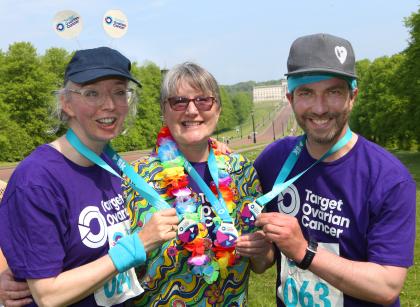
I don’t know if I always had a voice and just didn’t use it, or my diagnosis has led me to find it, but either way it’s given me a real purpose and I’m not afraid to speak up and represent those that are lost or falling through the gaps within our health system.
At that time, Target Ovarian Cancer were looking to create an action team in Northern Ireland and I quickly became involved. I like to think we found each other through social media activity and the work that the charity was doing. There is no specific gynae support network in Northern Ireland so after being inspired by the trusted information on the Target Ovarian Cancer website and their nurse helpline, I collaborated with a Cancer Nurse Specialist (CNS) in a health trust in Belfast to call for holistic needs assessments. This ensures that someone diagnosed with ovarian cancer is seen as a whole person and more than just their treatment plan. We have also recently co-created a video explaining what a holistic needs assessment is and why it’s so important to the experience of women with ovarian cancer.
Creating lasting change
It’s been wonderful to work with the team at Target Ovarian Cancer on several projects. Advocacy has given me a sense of purpose in an early retirement that I hadn’t planned for. It allows me to give something back and help others. Talking to people who are actively listening to you has a ripple effect and the more people that know about ovarian cancer and understand someone’s lived experience the better.
Someone with lived experience like mine is often the most important person in the room when it comes to campaigning for change. I like to call it our superpower; in that we can speak our truth, add a human level to the discussion, and say exactly what we want without being led by organisational rules and regulations.
I’m proud to have shared my lived experience far and wide, including through the press, television and online.
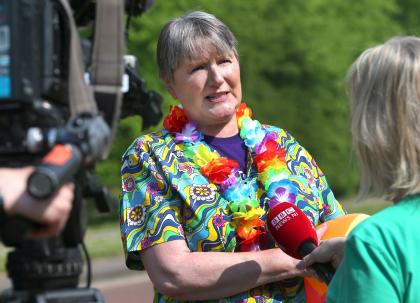
Over time, I have become increasingly interested in ensuring lived experience is considered in research projects specifically. I am an active member of the Northern Ireland Cancer Research Consumer Forum, a patient advisory group that works with researchers in the Northern Ireland Cancer Trials Network. Through this role, I have co-led, collaborated on or co-authored several research projects relating to ovarian cancer and cervical screening.
I am also a member of the Voices4Care group at the All Ireland Institute of Hospice and Palliative Care, through which I work with researchers and academics on initiatives focused on living with and beyond cancer.
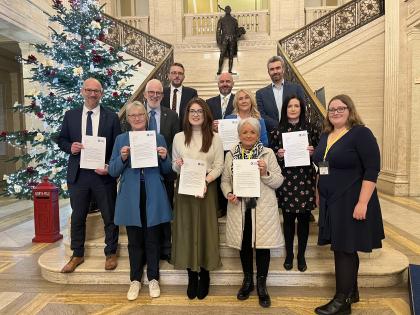
I further participated in the Northern Ireland Public Inquiry on Palliative Care and was invited to help launch its findings and recommendations at Stormont (the Northern Ireland parliament).
We’ve had some big moments in the last couple of years when it comes to raising awareness of the signs and symptoms of ovarian cancer and dispelling the myth around cervical screening and what it can detect. I look forward to what’s next and how I can continue to help and support the women of Northern Ireland.
A note from Laura, Campaigns Officer for Target Ovarian Cancer:
Christine is an integral part of our Northern Ireland action group. Her dedication and determination to raise awareness and use her voice to advocate for change have led to some milestone moments, not least meeting Northern Ireland’s Health Minister, Mike Nesbitt, in 2025. After that meeting, we secured his commitment to update official cervical screening information to state that cervical screening does not detect ovarian cancer. He was so moved by what Christine shared that he volunteered to make a short film with her and Pauline (another campaigner present in the meeting) for Ovarian Cancer Awareness Month - which they did.
In mid-2026, she met Minister Nesbitt again and discussed the Elahere issue - a treatment for platinum resistant high-grade serous epithelial ovarian cancer. In a BBC Radio Ulster interview he gave in June 2026, he spontaneously brought Christine up by name and said that, following that conversation, he would find the money for Elahere to be made available to women in Northern Ireland.
Christine has also allowed us to feature her on a new poster that we launched in the summer of 2026 to spread symptoms awareness throughout communities in Northern Ireland.
It has been fantastic to see Christine’s tireless advocacy recognised with awards. Christine has won the World Ovarian Cancer Coalition’s Impact Award for her work raising awareness of the signs and symptoms of ovarian cancer in Northern Ireland (November 2024), as well as the Irish Society of Gynaecological Oncology’s Laura Brennan Award for her advocacy around ovarian cancer, cancer research, and palliative and end of life care in Ireland (December 2025).
We are grateful for Christine’s partnership in driving change for women in Northern Ireland.
If Christine’s story has inspired you to campaign for change around ovarian cancer, you can find ideas and resources on our ‘Campaigns’ webpage, including how to sign up for our campaigner network.